Working dogs get old fast. Most working dogs live to about 8 to 9 years old. They are not pets and literally work themselves to death. When USAF working dogs are no longer able do their jobs, they are euthanized. When a handler's dog is, as most people say, "put to sleep," the handler is sent to Lackland Air Force Base to train a new dog and bring it back for service. In the U.S., the Air Force trains all of their dogs at Lackland Air Force Base and the handlers take the dogs back to the base to which they are assigned.
One of our handlers from Wright-Patterson Air Force Base, near Dayton Ohio, brought back a dog named Tiny Boy. During training, Tiny Boy did not bark. The instructors told the handler working him that this was the dog they would want if they were in Viet Nam. They did this young handler a disservice. The instructors should have known better. A dog that could not do its job was put into service. Tiny Boy was not aggressive and, therefore, saw no need to bark at anyone or anything.
All of the other handlers helped Tiny Boy's handler as he tried to improve his dog's skills. It did not take long before Tiny Boy got a nickname, Timid Boy. We were unable to make him aggressive. Today, Tiny Boy would probably have made a good drug sniffing dog. A gentle dog that could walk amongst people. But, he did not have the temperament which would make him an attack dog.
Everyone decided that Tiny Boy and Dawn should work together as much as possible. The Weapons Storage Area had two posts and we were paired up frequently. I guess the hope was that Tiny Boy would learn from the aggressiveness he observed in Dawn.
Tiny Boy's last night on post was a night that Dawn and I were working the Weapons Storage Area together with Tiny Boy and his handler. The alert truck showed up to give us coffee. Dawn was barking her head off when the truck drove up to the other side of the gate. Tiny Boy just stood there watching Dawn, but did not bark at all. One of the guys got out of the truck and kicked the gate. Dawn went berserk and would have torn the guy to pieces if she could have gotten through the fence. "Timid Boy" quickly ran and hid behind his handler. That was the last straw for the handler. Tiny Boy was relieved of duty.
Tiny Boy was retired from duty and euthanized. The necropsy revealed that Tiny Boy had a weak heart. Tiny Boy would have made a great pet, but he was not healthy enough to be an attack dog. The Air Force did not allow attack dogs to be rehabilitated to civilian life. It is sad that when a dog is no longer able to work that it is euthanized.
Sunday, February 22, 2015
Tiny Boy

 My retirement date is September 1, 2016. Kay and I will start our journey. Perhaps we will meet you during our travels. Our plan is to travel as long as we are both healthy. Our dog Jake will be with us. He loves camping, chasing chipmunks and traveling in the truck.
Contact us at: rawphotoart@yahoo.com
My retirement date is September 1, 2016. Kay and I will start our journey. Perhaps we will meet you during our travels. Our plan is to travel as long as we are both healthy. Our dog Jake will be with us. He loves camping, chasing chipmunks and traveling in the truck.
Contact us at: rawphotoart@yahoo.com
Sunday, February 15, 2015
No!
No!
One cold night, I was sitting in the break truck with Dawn's leash slammed in the door. She was not allowed in the truck with the driver or other handler. Unlike your average house pet with a waggy tail, Dawn would want to attack anyone who was close to me. Unlike my dog Jake, I could not tell her they were okay. The only thing she knew was, if you are close to my buddy, I WILL EAT YOU. So she sat outside in the cold bored to death, that is until Fred caught her attention.
Fred was driving the break truck. He wanted to call someone, so he went back to the maintenance shed to make his call. Dawn did not like Fred, but that was nothing personal, Dawn did not like anyone but me, and I liked it that way.
I do not know if Fred taunted Dawn on his way back to the truck, thinking he was safe, or if Dawn just got excited about Fred approaching the break truck. Either way, she was jumping around and barking when the door to the truck popped open. At first, Dawn was off balance, but then she got her footing and launched her attack upon Fred. If she bites Fred, it would be the same as if I had accidently shot Fred with my Colt 38 revolver.
I was out of the truck instantly, but I could not reach Dawn's leash fast enough. She jumped to attack Fred. She was attacking Fred's movement, which was his putting his arm up in front of himself to protect his body from the attack. I did the only thing I could do, I issued two verbal commands: NO and OUT. Out is a release command, even though she had not actually bitten Fred.
Dawn closed her mouth and her nose struck Fred's arm. When she landed on the ground, she turned her head back to me, confused about my commands. That gave me enough time to grab her collar and then her leash and I once again had her under control. That was closer to a court-marshal than I cared to be. Fred had to go change his underwear! After this incident, I always held Dawn's leash even if it was closed in the door.
My retirement date is September 1, 2016. Kay and I will start our journey. Perhaps we will meet you during our travels. Our plan is to travel as long as we are both healthy. Our dog Jake will be with us. He loves camping, chasing chipmunks and traveling in the truck.
Contact us at: rawphotoart@yahoo.com
Sunday, February 8, 2015
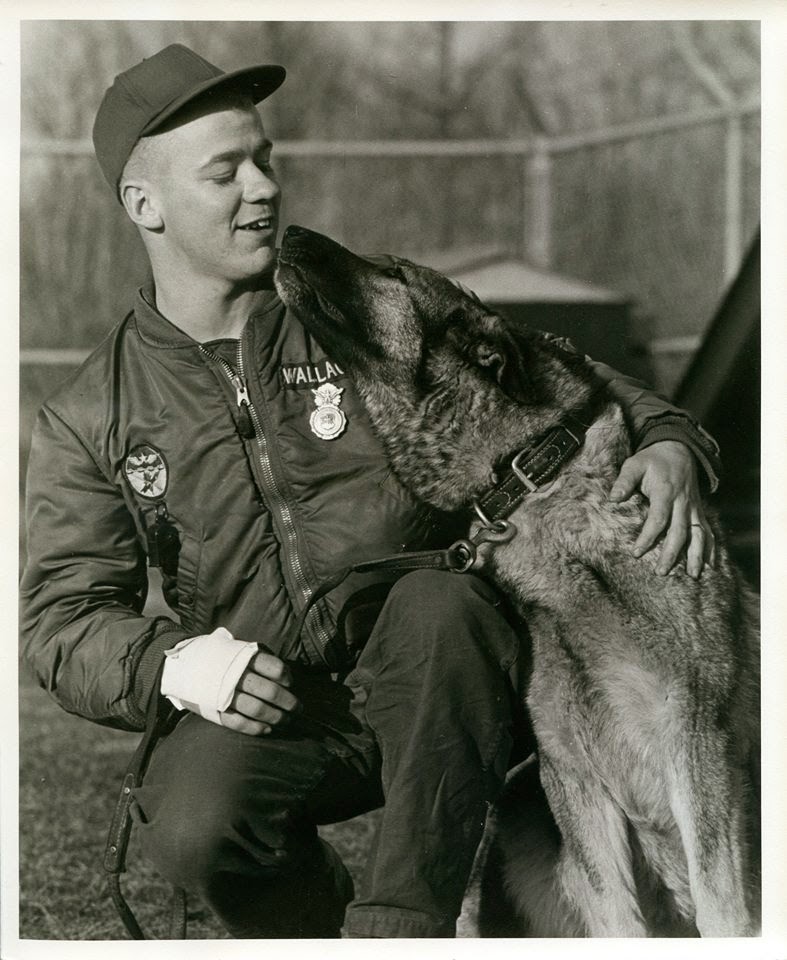
Why My Hand is Bandaged
Why My Hand is Bandaged

Before I start this story I must apologize to Tech Sgt. Richard Waite for being less than honest about what happened on post the night I was bitten, and to my mother for not being the truthful young man that she expected me to be at all times. I must also apologize to Dawn for vilifying her in this incident.
At Wright-Patterson Air Force Base we had three K-9 posts near the flight line where the alert ready B-52 bombers with nukes on board were parked. Two of the posts were between the taxiway and the runway. The boundaries of those two posts were 100 feet apart, which means that there should be no contact during the night between the two dogs and handlers.
Halfway between the two posts there was a transformer with a chain link fence around it and a free standing cabinet with the controls for the runway lights. It was common for the two handlers to put their duffle bags against the cabinet and sit on it while they chatted, read a book by flashlight, or occasionally napped. I was taught how to attach my dog's leash to the fence which would release with a tug of the loop but would tighten if the dog tugged on the leash.
Some guys came to work with the intention of sleeping. I tried very hard to stay awake. Walking my post, the way I should, always worked. One night, with my dog tied to the fence, I closed my eyes longer than I should have. The break truck started up the road from the taxiway, which I should have seen coming when it left the flight line. I stood up, and walked down the road to meet it. It took me a few steps before I realized that my dog was further in front of me than her six foot leash should allow. Dawn had eaten the leather in the center of her leash. I had a foot of leash in my hand and she had a foot of leash at her collar.
Two things: That was the last time I tied my dog to the fence and I never wanted to allow a truck or a person to get close to me before I was aware of it. After that time I tied the dog to my wrist with her leash and I taught her to alert on trucks. She already knew how to alert on people.
At the cabinet, we sat about five feet apart. This made my mentor, the Flight Chief, a little bit nervous. Between the leash and my reach, my dog could attack him if I was inattentive. We both had very aggressive dogs. Odd, but I remember his dog's name, Jumbo, but not his name. He was a veteran of ten or twelve years and I was a dog handler of very few months. He suggested that we make friends with each others dogs. It made sense to me, so I agreed.
We muzzled our dogs and each of us took turns at becoming friends with the other handler's dog. After a few nights, Jumbo's aggression had subsided, so I took off his muzzle and started patting his head. On the second pass, Jumbo snatched my hand. He bit my hand twice and when he went for a third bite, I pulled my hand from his mouth.
Now the reasons about the less than honest report that I filed about the dog bite:
- I was supposed to be at least 100 feet from another dog
- The Flight Chief was supposed to also be at least 100 feet from my dog and me
- A handler's dog biting a person is the same as having been shot by that handler
- It was not just my career at stake
- We both would have faced disciplinary action and rightfully so
The Flight Chief decided how I should write up the incident. Being young and naive, this is the report I wrote up about the incident:
As I was walking across my post around 0100 hrs, I slipped on a small patch of ice and stepped on Dawn's foot. She snatched my hand out of instinct and immediately released when she realized what she had done.
This made sense to the kennel master. Dawn was quarantined for rabies, just as a precaution. I worked nights during that time watching the kennels all night, while my hand healed and Dawn was quarantined. Dawn did not dispute the story and remained loyal to me.
My retirement date is September 1, 2016. Kay and I will start our journey. Perhaps we will meet you during our travels. Our plan is to travel as long as we are both healthy. Our dog Jake will be with us. He loves camping, chasing chipmunks and traveling in the truck.
Contact us at: rawphotoart@yahoo.com
Sunday, February 1, 2015
The Training of Airman Wallace
The Training of Airman Wallace
After I muzzled her, I clipped the leash to her collar, released her chain and walked her out of the kennel area into the training area where my training was about to begin.
Upon entering the training area, I put a choke chain on Dawn and removed her collar. The collar was worn during attack training and when working on post. The dogs knew that the collar meant work and the choke chain meant obedience and play time. The dogs loved their time in the training area. It was similar to when we had recess in elementary school--you had to behave yourself, but still had fun.
The kennel master observed Dawn and me as we worked. He stressed that I should issue my verbal commands in a stern loud voice each and every time. After I was doing well at that, he explained the hand signals for the verbal commands of come, sit, down and stay. He then had me use the hand signal and the verbal command together. Then we moved on to using hand commands without a verbal command. Dawn must have been bored to death. She was doing fine, but, interestingly, never got a treat. She worked for praise! I also learned to praise her every time she responded well. If she did not respond promptly, I was taught to jerk her choke chain and make her respond to my command. I was informed that a dog's neck is strong and muscular and it would not hurt her when I jerked on the choke chain. I was taught that dogs are much like children in that they will always test you to make sure you really mean it! If you do not correct them immediately, they become unruly and impossible to control. This training was two fold: (1) to teach me how to control my dog, and (2) to teach my dog to respond to my commands. It is important that the dog responds only to the commands of its handler. It is also important that the dogs are not looking for treats, as it would be a dangerous thing if they were looking for treats rather than attacking an intruder, or, worse, not even alerting on him. Each dog has to want to work because of the bond with its handler.
The obedience training went well; however, the exercise part did not. Dawn wanted no part of running the obstacle course. I inherited my dog from a lazy dog handler. He did not make her run the obstacle course and she did not want to start now. The kennel master, a really sympathetic guy, told me I could not take Dawn to post until she could run the obstacle course, and that I had one week to get her trained. It was tough. How do you make a dog do something it does not want to do? I dragged her through every obstacle. By the end of the week, she started realizing that she had no choice and that it would be easier if she ran and jumped rather than being dragged through each obstacle.
The obstacle course ran up one side of the training area, across the back and then along the other side of the training area. It started with a jump through a window about three feet off the ground, then a jump over a four foot barrier. The last obstacle on the left side looked like an inverted V. It was six feet high and had ribs across the top half. The dog was to jump, put the front legs across the top and use the ribs to give traction for the hind legs to push the body over the top. Across the back was a narrow ramp to a narrow beam that was about five feet above the ground, and the dog would jump off of it when he got to the end. Then the dog was to turn the corner and run up a steep ramp to a platform about seven feet high with stairs on the other side. The last obstacle was a ten-foot tunnel through which the dog had to crawl.
Dawn and I worked hard all week. I had to prove that I had what it took to be a dog handler and Dawn wanted to prove to me that she was my best friend.
Foot note: After one week, Dawn could successfully run the obstacle course while I ran beside her with her leash clipped to her choke chain. This satisfied the kennel master and Dawn and I were assigned to B Flight. After two weeks, Dawn ran the obstacle course off leash while I ran beside her. We still had more work to do. After one month, I sent Dawn off leash to run the obstacle course, while I walked to the end of the tunnel to wait. Dawn was able to run the whole course without missing an obstacle. Both of us had been successful! Did it come without hard work? NO! When I first let Dawn off leash, she ran around the obstacles that she did not want to do. I went back to the instructions of the kennel master, "Immediately correct your dog and make your dog do what it is commanded to do." Dawn soon realized that she should not bypass any obstacles. She really wanted to please me. Yes, we were both pleased with the end results!
My retirement date is September 1, 2016. Kay and I will start our journey. Perhaps we will meet you during our travels. Our plan is to travel as long as we are both healthy. Our dog Jake will be with us. He loves camping, chasing chipmunks and traveling in the truck.
Contact us at: rawphotoart@yahoo.com
Sunday, January 25, 2015
How I met Dawn, 127X
How I met Dawn, 127X
As you always remember your first love, I, too, remember my first dog, Dawn.
It was in early fall of 1966 that I was assigned to the K-9 unit at Wright-Patterson Air Force Base. I was shown around the kennels and promptly put to work. My job was to feed the dogs in the morning, clean their runs during the day, and familiarize myself with all of the dogs. The dogs felt safe in the kennels and became familiar with the kennel personnel who took care of them during the day. I was soon making friends with Dawn and started patting her head as long as she had a milk bone in her mouth! Dawn was half German Shepherd and half Norwegian Elk Hound. She weighed 80 pounds and was one of the most aggressive dogs in the kennel. Dawn was well trained and I was the one who needed to be trained.
It was in early fall of 1966 that I was assigned to the K-9 unit at Wright-Patterson Air Force Base. I was shown around the kennels and promptly put to work. My job was to feed the dogs in the morning, clean their runs during the day, and familiarize myself with all of the dogs. The dogs felt safe in the kennels and became familiar with the kennel personnel who took care of them during the day. I was soon making friends with Dawn and started patting her head as long as she had a milk bone in her mouth! Dawn was half German Shepherd and half Norwegian Elk Hound. She weighed 80 pounds and was one of the most aggressive dogs in the kennel. Dawn was well trained and I was the one who needed to be trained.
After I had been working in the kennels for a few days, the kennel master said to me, "Here's your leash and muzzle. It is time to take your dog out or go back to the Security Flight." Now came the moment when I had to overcome my childhood fear of dogs and step into the range of the teeth of one of the most aggressive dogs in the kennels. The butterflies in my stomach began choking my throat. I started repeating in my mind, "You can do this, Russ!" My knees were weak, but I opened the gate and entered the kennel area despite my nervousness.
Because the SAC unit was not a permanent unit on the base, the kennels were temporary kennels, not the normal concrete floor, closed in runs separated by concrete and chain link walls. We had dog houses on a pedestal with pea stone for the run. Their chain was around the pedestal post and they formed a ring around their space with the pea stone just from their running back and forth. Their dog houses were outside in the weather, not covered by a building with a roof. Dawn's area was at the furthest point from the gate. I walked through the aisles and Dawn saw me coming with the leash and the muzzle. She started jumping up and down, not with aggression, but with anticipation. She knew that she was going to be taken to the training area for exercise. It was not uncommon for the daytime kennel staff to exercise a dog that was between handlers. As I approached the ring of pea stones that defined the edge of her run, Dawn sat and waited for me to put on her muzzle. After I muzzled her, I clipped the leash to her collar, released her chain and walked her out of the kennel area into the training area where my training was about to begin.
Because the SAC unit was not a permanent unit on the base, the kennels were temporary kennels, not the normal concrete floor, closed in runs separated by concrete and chain link walls. We had dog houses on a pedestal with pea stone for the run. Their chain was around the pedestal post and they formed a ring around their space with the pea stone just from their running back and forth. Their dog houses were outside in the weather, not covered by a building with a roof. Dawn's area was at the furthest point from the gate. I walked through the aisles and Dawn saw me coming with the leash and the muzzle. She started jumping up and down, not with aggression, but with anticipation. She knew that she was going to be taken to the training area for exercise. It was not uncommon for the daytime kennel staff to exercise a dog that was between handlers. As I approached the ring of pea stones that defined the edge of her run, Dawn sat and waited for me to put on her muzzle. After I muzzled her, I clipped the leash to her collar, released her chain and walked her out of the kennel area into the training area where my training was about to begin.
My retirement date is September 1, 2016. Kay and I will start our journey. Perhaps we will meet you during our travels. Our plan is to travel as long as we are both healthy. Our dog Jake will be with us. He loves camping, chasing chipmunks and traveling in the truck.
Contact us at: rawphotoart@yahoo.com
Friday, January 23, 2015
Why I joined the Air Force
Why I joined the Air Force
Way back in 1965 the U.S. of A. did not have an all volunteer army like it does today. There was the draft and there was no lottery number. Anyone could be called at anytime, unless they were in college. Well, I had dropped out of college and went to work and knew that I was probably going to get drafted. The Vietnam War was heating up. I did not want to carry a gun and slosh through rice paddies, so I went to my Air Force recruiter and took my tests and enlisted. I was scheduled to be sworn in on January 25, 1966 in the Administrative Field where I had my highest scores on the aptitude test.
In December of 1965, I got a notice to report for induction to the Army on December 23rd. In a panic I called my unscrupulous Air Force recruiter. He told me he could get me a 30 day deferment if I changed my field from Administrative to General. I had really been looking forward to being a clerk sitting at a comfy desk writing reports. But, I really did not want to go into the Army 2 days before Christmas. 20 year old kids just do not have enough life experiences to make good life changing decisions. My scores were not as good in the General Field. Basically I had the choice of being a cook, an auto mechanic, or an air policeman. I had no mechanical skills at the time and did not know how to boil water, so I chose Air Police. Why not, I could salute the officers as they entered the base. Easy enough job, so I thought. So I chose Air Police. I was sworn in on January 18, 1966.
Well, little did I know that there was a branch of Air Police called Security Police. I ended up in Security Police, in a SAC unit attached to Wright-Patterson Air Base, near Dayton Ohio, carrying an M-16 and guarding B-52 bombers loaded with nukes ready to launch at those nasty Russians. I loved the hours: 3 swings (4 to midnight), three mids (midnight to 8) and three days (8 to 4) with 72 hours off and then do it all over again. I never knew if it was day or night when I woke up. During the winter, 5 at night was as dark as 5 in the morning. Scary when you wake up and are not sure if you slept through your shift and were legally AWOL.
It did not take me long to realize that I should become a dog handler, even if they only worked at night. Here is what I saw: the sentry dog handlers stood guard mount with the security flight at 4 PM, posted when it got dark (9 or so during the summer) and got off post at midnight the same as me. Then on the midnight shift they posted with me at midnight, but got off post when it got light, put there dogs away, went to breakfast and were in bed before I got off post at 8. Better than that, they got 80 hours off. I did the math: 9 days on 72 hours off vs 6 days on 80 hours off. It was a no brainer, I would apply for K-9.
Well I did. Surprisingly there were only two candidates to fill the one open position. There was me, who was afraid of dogs growing up and one other guy. We both had negatives. The kennel master thought I was too small to handle the dog and he thought the other guy was an arrogant asshole. I got the nod. I decided it was time to get over my childhood fear of dogs. The picture of me in the profile is of me and my dog Dawn, 127X. Dawn was an incredibly aggressive sentry dog, but as you can tell, she bonded well with me.
 My retirement date is September 1, 2016. Kay and I will start our journey. Perhaps we will meet you during our travels. Our plan is to travel as long as we are both healthy. Our dog Jake will be with us. He loves camping, chasing chipmunks and traveling in the truck.
Contact us at: rawphotoart@yahoo.com
My retirement date is September 1, 2016. Kay and I will start our journey. Perhaps we will meet you during our travels. Our plan is to travel as long as we are both healthy. Our dog Jake will be with us. He loves camping, chasing chipmunks and traveling in the truck.
Contact us at: rawphotoart@yahoo.com
Thursday, January 22, 2015
No Contact with Kilo 9
No Contact with Kilo 9
(As published here)
“Bravo 2 to Base.”
“Go ahead Bravo 2, this is Base.”
“Shots have been fired on Kilo 9. There are outgoing tracer rounds.”
“10-4. Base to Kilo 9.”
.... (no answer) ....
“Base to Kilo 9.”
..... (no answer) ....
“No contact with Kilo 9.”
It was a very hot and humid August night at Phan Rang Air Force Base. The K-9 units were called to work early this night. Both the Early Flight and Late Flight stood guard mount together.
We were told the name of the North Vietnamese sapper unit which was going to attack us. We were told that the radio net was being jammed and we were only to check our radio if we thought it might have a problem. It was our routine to do a radio check as we were posted. This served two purposes; it let our Operations Center know we were posted, as well as insured the radio worked.
The Early Flight, which normally posted just after dark, was posting before dark. The Late Flight, which normally posted two hours after the Early Flight, began posting as soon as the trucks returned to the kennels.
I was on the Early Flight and assigned to Kilo 9. As instructed, I did not check my radio after being posted, because I was receiving all the radio chatter. It was just a little after 1930 hours and I passed the gate guard as I walked down towards the fence line. At 7:30, the double-gated entrance was locked and unmanned overnight. I had about 200 yards of perimeter to patrol, so I made a sweep of the area and it was secure.
Feeling happy and safe, I sat down on a rock and plugged my ear plug into my pocket transistor radio and tuned in the oldies on the Armed Forces Radio Network. Then, something I had never done before. I plugged an ear plug into my walkie-talkie, so I could still hear the radio transmissions. I felt good. Both radios were working, not blaring, giving away my position.
I stood, and noticed Tusky was alerting towards the gate and the road towards the Strip, a village that had sprung up close to the base to service the needs of the off-duty personnel. I could hear the sounds of merriment wafting in on the gentle breeze.
I thought to myself, Tusky, you silly dog. I can hear those sounds. too. They are nothing. True, the noises I heard were nothing, but the noises Tusky was alerting to were something. He had picked up the sounds and perhaps the scent of some people coming up the road towards the base.
The sky was barely light, still outlining the tree tops, but the tree line was plunged into total darkness. I was 30 feet from the gate and I could not see it. But I could hear the sounds of people approaching the gates, even though I could not see them.
It was time to call in my dog’s alert. I should have believed him from the start. He was trained to see, hear, and smell things my senses could not discern. He did his job, so I had to catch up and do mine, by calling in the evolving situation on my radio. I called it in and received a 10-4 from Base.
Little did I know, Base did not receive my transmission. The 10-4 I heard was for someone else’s radio transmission.
I did not hear control dispatch the Security Alert Team for my back up, because they had not done so. I did not notice the omission, because I was busy focusing on what was happening right in front of me, about 40 feet away.
The men I still could not see were shouting and rattling the gates. It was an Asian language, and I remembered the briefing at guard mount about the sapper unit that was expected to attack us. We had been told that sapper units would probably be high on something which would help them overcome their fear of the dogs guarding the perimeter. These men had no fear of my dog who was being very vocal.
I found a huge rock to crouch behind just off to one side of the road. I still did not know how many men were out there in the darkness. I felt protected, and then they started climbing the first of two gates. I needed to inform the Control Center of the changing situation.
“Kilo 9 to Base.”
... (no response) ...
“Kilo 9 to Base.”
... (no response) ...
“Kilo 9 to Bravo 1.”
... (no response) ...
“Kilo 9 to Bravo 2.”
... (no response).
The men climbed the first gate and were crossing the ten feet of open space to get to the second gate. The huge rock I was crouched behind shrank to the size of a pea in my mind. I ran back 30 yards and found a rock that was twelve feet high and had a shear edge like the corner of a house. My dog was barking out of control, his adrenaline rush probably comparable to mine.
I refocused on the sounds in front of me. The men were shouting and shaking the chain link gate. Then they started climbing the last gate. I tried my radio again, but first I pulled out the ear plug. It did not matter that it would blast out radio transmissions, because my dog was louder than the radio.
I tried calling Base and the two towers that were close to me, but the ear plug was not the problem. They still did not receive my transmissions. My radio’s battery was strong enough to receive, but not strong enough to transmit. A simple radio check would have resolved that when I was posted. I could not worry about that, because there was an unknown number of men walking up the road towards me.
Suddenly, two silhouettes appeared in the middle of the road. I gave them an order to halt and they did not. My dog was barking like crazy and jumping around wanting to get to them. My warning shot was straight at them. I continued firing and they both fell. Then one of them jumped up and ran for cover, and I shot twice more at him. He fell in the ditch at the side of the road.
I thought, how many others made it to cover in the rocks? I ran from my position and took up another defensive position further up the road. Tusky had calmed down and was not barking.
The tower guard called in the shots fired and Control tried to reach me. I tried to answer, but I could not. I heard Base dispatch the Security Alert Team and then I shut off my useless radio. The base went from Yellow to Red Alert.
I finally had time to breathe and think. My dog was calm, but alert. I began wondering how many men were part of this penetration attempt. One man was lying in the ditch moaning, the other was babbling something, probably giving information to his comrades who had made it to cover in the rocks.
I wondered how many times I had fired and how many rounds I had left. I was carrying a CAR-15 with 18 rounds in the magazine. I was firing it one-handed, like a pistol on semi-automatic. But what if someone charges me from the rocks and I run out of ammo?
I unclipped Tusky’s leash and took hold of his collar. He was easy to control, because he had calmed down. If I run out of ammo, I could let Tusky go and hopefully get my magazine changed while the person struggled with an 80-pound attack dog.
All stayed quiet. Two dog men from the Late Flight were posted at the perimeter road and shouted out to me as they approached. I was never so glad to see two guys as I was right then.
The supervisor for the Late Flight showed up next. He drove his jeep with its lights on right down to where the South Korean non-commissioned officer was lying in the road. Fortunately for him it was not an attempted penetration of the base by a North Vietnamese sapper unit.
Two South Koreans were late returning from the bars and whore houses of the Strip. The Korean compound had a curfew of 7:00 PM, the airbase, a curfew of 7:30 PM, and the two Koreans arrived at the gates at 7:45 PM.
Both Koreans lived. They were sent to do two years hard labor in a Korean prison. I had fired 8 rounds and hit each of them twice. I found that out, during my four-hour investigation by the Korean Military Police. I had to explain to them exactly what happened and I made sure my explanation was in line with the MACV Rules of Engagement.
If I had shot the unarmed Koreans when they were outside the fence, I would have been the one going to jail. I could only shoot at them if they shot at me first, or if I saw them setting up a crew-served weapon to be used against the base. I did my job, scared as I was.
Well they did not shoot at me, so that took me to the next scenario: penetration of the base. But I still do not have the authority to shoot them. I must give them two verbal warnings. Well, I gave them one verbal warning in Vietnamese and English -- I figured my dog barking was an even bigger halt command than my verbal one.
That did not stop them, so I gave them a warning shot -- I just did not tell the Koreans that it was straight at them. I again figured that Tusky’s bark was as much a warning shot as a shot from my gun. The two Koreans knew they were crossing a secure post and failed to halt.
The Koreans, as they interrogated me, asked a couple of interesting questions. First, “Why didn’t I tell them to halt in Korean as well?”
Let’s see, I thought it was an attack by a North Vietnamese sapper unit. Why would I even think it might be Koreans? Besides, I was so frightened, I could not remember the Korean word for halt.
Second, they asked me if I walked over and shot the guy lying in the ditch, because he was shot once through the back.
Well, he turned his back on me when he was running for the rocks and I fired twice at him. Not an easy shot, shooting one-handed from the hip, while your dog is jumping around trying to get to the guy. But they already knew the answer. All of my casings were in the one spot where I stood and fired.
After I spent four hours giving my statement and a signed, handwritten, report to the Koreans, the U.S. Air Force spent three and a half hours interrogating me. There is nothing worse than putting your life on the line and watching the justice system decide whether you acted properly, or not.
That incident had to be one of the most frightening things to happen in my life. An almost equally frightening event occurred two nights later. The Koreans I shot belonged to a White Horse Division artillery battery.
The following night, I did not go to post, because I was up all day being investigated for any wrongdoing by the Koreans and the U.S. Air Force. I had the night off. The post I should have been on was shelled short by the Koreans. Occasionally, they do make an error in their co-ordinates.
The second night after the incident, I was back on duty protecting the base from intruders who wanted to blow up our planes and I was taking cover from the artillery rounds which shelled my post short for the second night in a row.
As was normal, I heard the howitzers firing, but unlike normal, they were not hitting a point 1500 meters, or more, off base. The three rounds were whistling in on my position. It was too late to get to a bunker, by the time I realized I was the target.
I hit the ground and tried to pull my dog down -- he wanted to stand up and howl at the whistling. We survived unscathed as the shrapnel whooshed over our heads. I could hear it pepper the tin that surrounded the sandbags in the tower close to my position.
The tower guard did not have time to get to his bunker. He ducked behind the sandbagged walls of the tower and escaped injury.
Our Operations Officer visited the Koreans the next day and told them, "Once might be a mistake, but twice is not." He let it be known that it must not happen again. Thankfully it stopped.
My wife and I are campers. There is a firing range just over the hill from the campsite our trailer is on. I guess hearing shots being fired can trigger long hidden memories.
One evening, I had the most frightening nightmare I have ever had. I dreamed we were sitting in front of our fire pit enjoying a drink, when some rounds started whistling in on top of us. My struggle was not to get my dog down, but to convince my wife to get out of her chair and lie prone.
I awoke before it concluded, but it seemed as real as the event in Nam. I was shaken and did not sleep well that night. Every now and then, I get a crazy dream like that. I am thankful it does not happen often.
Russell (Russ) Wallace
USAF - Security Police
Sentry Dog Handler
Vietnam - February 1968 to February 1969
My retirement date is September 1, 2016. Kay and I will start our journey. Perhaps we will meet you during our travels. Our plan is to travel as long as we are both healthy. Our dog Jake will be with us. He loves camping, chasing chipmunks and traveling in the truck.
Contact us at: rawphotoart@yahoo.com
Subscribe to:
Posts (Atom)